
INTRODUCTION
If you’ve ever thought, “What if my EV runs out of charge in the middle of the road?” you’re not alone. That exact fear is what stops many people in India from switching to electric vehicles. And yes, you’re here to find out if that fear is actually real or just overhyped.
By the end of this guide, you’ll clearly understand whether EV range anxiety is something you should worry about in 2026 — or ignore completely. We’ll break down real-world data, daily usage patterns, charging networks, and the one misunderstanding that creates most of this fear.
This site focuses on practical automobile insights for Indian users not theory, not hype, just what actually works on Indian roads. And here’s the truth most people miss: range anxiety is not about battery limits it’s about mindset and outdated assumptions.
What Is EV Range Anxiety and Why It Matters Right Now
Range anxiety simply means the fear that your electric vehicle will run out of battery before you reach your destination or a charging point.
Sounds reasonable at first. But when you actually look at how people drive daily, the fear starts to fall apart.
Most modern EVs in India offer between 250 km to 500 km on a single charge. According to multiple mobility reports (including NITI Aayog insights), the average Indian daily commute is around 30–40 km. That means even a basic EV covers 5 to 7 days of driving on one charge.
The gap between real usage and perceived risk is massive.
What’s changed recently is infrastructure. In 2020, finding a charger outside major cities was hard. In 2026, highway fast chargers, mall chargers, and even society-based charging points are becoming common.
Here’s a real-world observation: when people first switch to EVs, they check battery percentage constantly. After 2–3 weeks, most stop caring — because they realize they’re never even close to running out.
Range anxiety matters right now because it’s the last psychological barrier. Technology has already solved the actual problem.
Who This Is For Eligibility or Requirements
This guide is especially useful if you fall into one of these categories:
- Daily city commuters
If you drive within city limits for office, college, or business work, EVs are almost perfect. Your daily usage is predictable, and you can charge overnight without thinking about it. - People with home or parking charging access
If you have a dedicated parking spot (home, society, or office), you’re already in the ideal situation. Charging becomes as simple as plugging in your phone. - Ride-sharing or delivery users (controlled routes)
If your routes are planned — like Zomato delivery, Uber city rides, or business logistics — you’ll rarely face range issues because you can plan charging breaks. - Highway travelers (with planning mindset)
Long-distance drivers can use EVs comfortably now, but only if they’re willing to plan stops. Apps like PlugShare and Tata Power EZ Charge make this easy. - People expecting EVs to behave exactly like petrol cars
This is the most misunderstood group. If you expect instant refueling anywhere in 2 minutes, EVs will frustrate you. EVs require a slightly different habit — charge when parked, not when empty.
Who should wait?
If you live in an area with zero charging infrastructure and no private parking, switching right now may still feel inconvenient. Not impossible but not smooth either.
How It Actually Works Complete Process
Here’s how EV usage really works in daily life, step by step:
Step 1: You charge at home (or base location)
Most EV owners charge overnight using a standard home charger. It usually takes 5–8 hours depending on the battery size.
What nobody tells you: you don’t need to charge to 100% every time. Most users charge between 20% to 80% for better battery health.
Step 2: You drive normally without thinking about range
This is where the mindset shift happens. Instead of “drive → empty → refill,” EV users follow “charge when parked.”
In practice, this means your battery rarely drops below 30–40% in daily use.
Step 3: Apps guide you to charging points
Apps show nearby chargers, availability, pricing, and even real-time status. This removes the guesswork completely.
One thing many guides skip: always check user reviews of a charging station. Some chargers show “available” but may not be functional.
Step 4: Fast charging for longer trips
On highways, DC fast chargers can charge 20% to 80% in about 30–60 minutes depending on the car.
This aligns naturally with food or rest breaks. Most people find that they stop anyway after 2–3 hours of driving.
Step 5: You adjust driving habits slightly
Driving aggressively reduces range. Smooth driving increases it significantly sometimes by 10–20%.
The surprising part? Many users start driving more efficiently without even trying.
The key shift is this: EVs are not limited by range they are optimized by routine.
Comparison Table EV Options Side by Side
| Name/Option | Key Feature | Best For | Limitation | Verdict |
| Low-range EV (200–250 km) | Affordable, basic battery | Daily city driving | Not ideal for frequent highways | Perfect for urban users |
| Mid-range EV (300–400 km) | Balanced range and price | Mixed city + occasional travel | Slightly higher cost | Best overall value |
| Long-range EV (450+ km) | Extended range, fast charging | Frequent highway users | Expensive upfront cost | Great but not necessary for most |
Most Indian buyers overestimate how much range they need. If your daily usage is under 50 km, even a 250 km EV is more than enough.
Real Benefits With Numbers Where Possible
When you actually switch to an EV, here’s what changes:
- Fuel cost drops dramatically
Petrol costs around ₹100/litre. EV charging costs roughly ₹1–₹1.5 per km. That’s a 60–80% saving for regular drivers. - Weekly charging replaces daily fuel stops
If you drive 40 km daily, a 300 km range EV needs charging only once a week. That’s fewer interruptions than petrol cars. - Range becomes predictable
Unlike fuel, EV range depends on your driving style. Once you learn your pattern, you can estimate range very accurately. - You stop worrying about “empty tank” moments
Most people never let their battery drop too low. That panic moment you get with a blinking fuel light? It almost disappears. - Less dependency on external infrastructure
This is the benefit most articles ignore. When you charge at home, you don’t depend on petrol pumps at all.
The biggest benefit is mental once you trust your usage pattern, the anxiety simply fades
Mistakes Most People Make and the Fix
One common mistake is assuming advertised range equals real-world range.
Manufacturers show ideal conditions, but real driving gives about 10–20% less. This leads to unrealistic expectations. The fix is simple: always calculate your usage based on 80–90% of claimed range.
Another mistake is waiting until battery drops very low before charging.
This habit comes from petrol cars. In EVs, it creates unnecessary stress. Instead, charge whenever convenient — even if battery is at 40%.
People also ignore charging infrastructure apps before buying.
They assume chargers will “just be there.” When they can’t find one easily, anxiety increases. The fix: check charger density in your area before purchase.
Many new EV users drive aggressively at first.
Rapid acceleration drains battery faster and creates the illusion of low range. Smooth driving can improve range significantly without effort.
The most subtle mistake: overthinking rare scenarios.
“What if I get stuck?” sounds logical, but most drivers never face this situation. Planning for everyday usage matters more than rare edge cases.
Expert Tips That Actually Work
Plan your first week carefully.
Track how much battery you use daily. Once you see real numbers, your confidence increases quickly.
Use 20–80% charging rule.
Keeping battery between these levels improves long-term battery life and keeps charging cycles efficient.
Always have one backup charger location saved.
Even if you rarely use it, knowing it exists removes mental stress completely.
Pre-condition your battery when possible.
Some EVs allow this. It improves efficiency, especially in extreme weather.
Drive in Eco mode in city traffic.
It smoothens acceleration and gives better range without affecting comfort.
Here’s a surprising one: don’t chase maximum range constantly.
Many users become obsessed with squeezing every km. In reality, using the car normally is more practical and stress-free.
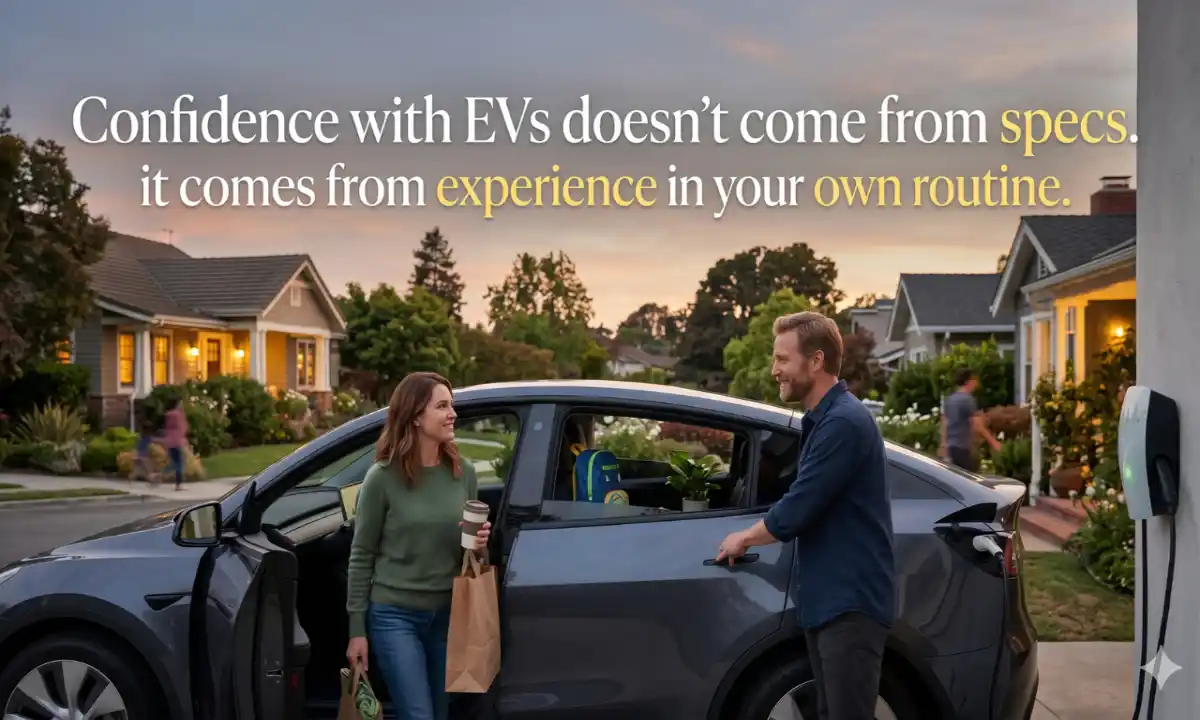
Confidence with EVs doesn’t come from specs it comes from experience in your own routine.
Frequently Asked Questions
Is EV range anxiety real in India?
It exists, but mostly as a perception problem. Real-world data shows most users don’t even use 50% of their battery daily. Once people understand their usage pattern, the anxiety reduces quickly.
How far can EVs actually go on one charge?
Most EVs in India offer 250 km to 500 km per charge. In real conditions, expect around 200 km to 450 km depending on driving style and traffic.
What happens if my EV runs out of charge?
The car will slow down and eventually stop, similar to running out of fuel. Roadside assistance and mobile charging services are now available in many cities, so you’re not stranded for long.
Are charging stations easily available in India?
In metro cities and highways, availability has improved a lot. Apps can show nearby chargers instantly. Smaller towns are catching up but still developing.
Is EV good for long-distance travel?
Yes, but planning is required. You need to map charging stops in advance. Once you do that, long trips become predictable and manageable.
How often do I need to charge an EV?
Most users charge once every 3–7 days depending on usage. Daily charging is not necessary unless you drive long distances regularly.
Does AC reduce EV range?
Yes, but not drastically. It may reduce range by around 5–10%. Driving style has a bigger impact than AC usage.
Is battery degradation a concern?
All batteries degrade over time, but modern EV batteries are designed to last 8–10 years. Real-world data shows slower degradation than expected.
Which EV range is enough for city use?
For most Indian cities, even 200–250 km range is sufficient. Anything above 300 km gives extra comfort and flexibility.
Quick Summary Take This Away
Most people fear EV range because they imagine worst-case scenarios instead of looking at daily reality. The average Indian drives less than 50 km a day, while even basic EVs offer 250 km or more per charge. That gap alone shows why the fear doesn’t hold up.
Charging habits are different from petrol cars, and that’s where confusion begins. Instead of waiting for empty, EV users charge when convenient — usually at home. Once this routine sets in, range stops being a concern.
Infrastructure has improved enough in cities and highways to support regular use. Apps make it easy to find and plan charging points, removing uncertainty.
The biggest shift is mental. When you actually start using an EV, you realize you’re rarely close to running out of charge. That’s when range anxiety disappears naturally.
If you’re considering an EV, focus on your real driving pattern — not hypothetical situations.
CONCLUSION
Range anxiety feels real until you match it with real usage data. That’s where it breaks. Most drivers don’t need the full range their EV already provides, and once they experience daily charging convenience, the fear fades on its own.
The real limitation isn’t battery capacity anymore — it’s outdated thinking carried over from petrol cars. When you adjust your habits slightly, EVs become easier to manage than expected.
If you’re still unsure, test-drive an EV for a few days or rent one. That firsthand experience will answer more questions than any spec sheet ever will.
You don’t need to eliminate range anxiety completely — you just need enough real-world clarity to stop it from controlling your decision.
Also Read : EV Charging vs Petrol Cost | 12 Month Real Breakdown (2026)